

Chinese Automakers: From Global Export Surge to MENA Market Transformation

The global automotive industry is undergoing one of the most significant structural shifts of the past three decades Chinese automakers have moved from being largely domestically focused manufacturers to becoming the fastest-growing vehicle exporters in the world, reshaping competitive dynamics across multiple regions. Export momentum is now translating into tangible market disruption across MENA, where demand for technology-rich SUVs and electrified portfolios is accelerating faster than many legacy networks can adapt. China’s Export Surge Rewrites the Global Competitive Landscape In 2019, China exported approximately 1.0 million vehicles. By 2023, exports had increased to 4.9 million units. In 2024, export volumes reached approximately 5.8 million vehicles, representing a compound annual growth rate of more than 40% over five years. Based on confirmed production capacity, logistics throughput and order pipelines, exports in 2025 are tracking towards 6.6 to 6.9 million units. This rate of expansion is historically unprecedented, with no major automotive exporting nation scaling international shipments at this speed within a comparable timeframe. What Is Driving the Export Acceleration Two structural forces sit behind the surge. First, China’s domestic automotive market has entered a phase of extreme competition, with well over 100 active vehicle brands competing for share. Price pressure has intensified, margins have compressed, and export growth has become a requirement to sustain scale utilisation and financial viability. Second, Chinese OEMs have reached a level of product, manufacturing and operational maturity that enables them to compete globally. Platforms are now developed with international markets in mind, allowing regulatory compliance, localisation and cost optimisation to be engineered at design stage rather than retrofitted later. Global Expansion Beyond North America Chinese brands remain largely absent from the United States. Outside North America, however, expansion has been rapid and measurable. In markets such as Mexico, Chinese manufacturers now account for more than one-fifth of new vehicle imports. In the United Kingdom, Chinese brands have reached approximately 13% of new vehicle registrations, driven primarily by SUVs and electrified models. Australia, Southeast Asia and parts of Eastern Europe show similar patterns, with Chinese brands moving from negligible presence to mid-single or low-double-digit market share within three to five years. This growth is broad-based rather than concentrated, spanning passenger cars, SUVs, pickups, light commercial vehicles and premium-positioned electric models. Speed as a Competitive Advantage One of the defining differentiators of Chinese manufacturers is development speed. Typical vehicle development cycles in China now range between 24 and 36 months, compared with 48 to 60 months for many legacy manufacturers. High levels of vertical integration — particularly in batteries, power electronics and software — enable faster iteration, lower cost volatility and tighter control over innovation timelines. As a result, vehicles entering global markets often include advanced digital interfaces, over-the-air update capability and driver assistance systems as standard equipment, raising customer expectations across multiple price segments. Electrification as a Structural Edge Electrification is central to China’s competitive position. In 2024, new energy vehicles accounted for approximately 52% of all new vehicle sales in China. Chinese manufacturers control a dominant share of global battery production capacity and much of the associated supply chain, translating into battery pack cost advantages estimated at 20–30% lower than many non-Chinese competitors. For export markets, this enables Chinese EVs to be priced competitively while preserving margin, accelerating adoption in regions where affordability has previously constrained demand. From Global Momentum to the MENA Market The Middle East and North Africa is emerging as one of the most strategically important regions within China’s export strategy. The region aligns closely with Chinese OEM strengths, including strong demand for SUVs and crossovers, high acceptance of technology-rich vehicles, importer-led market structures enabling faster brand establishment, and government-backed mobility and electrification agendas. As a result, Chinese vehicle imports into key MENA markets have grown at double-digit annual rates since 2021. From near-zero presence five years ago, Chinese brands are now estimated to account for 12–15% of new vehicle sales in parts of the GCC. The UAE and Saudi Arabia function as anchor markets, both in volume and regional influence, with expansion radiating into neighbouring markets. Electrification Gains Commercial Relevance in MENA Electric vehicle adoption in MENA is moving from pilot phase to early scaling. Between 2021 and 2024, EV and plug-in hybrid registrations in the UAE increased more than fourfold. Saudi Arabia is following a similar trajectory from a smaller base, supported by infrastructure rollout, fleet electrification initiatives and regulatory clarity. Chinese manufacturers are well positioned to benefit by offering EVs and plug-in hybrids across multiple price points, often with higher specification levels than established competitors. In a region where diesel passenger cars are largely absent and fuel pricing is no longer the primary purchase driver, electrification is becoming commercially viable earlier than many expected. Implications for Dealers and Importers For dealers and importers, the rise of Chinese OEMs presents both opportunity and pressure. Opportunities include accelerated volume growth, access to competitive electrified portfolios and flexible commercial structures. Pressures include intensified price competition, rising customer expectations around technology, and the need to upgrade aftersales capability to support software-driven and electrified vehicles. Aftersales readiness is becoming decisive: EV-capable workshops, trained technicians, parts availability and digital diagnostics are no longer optional for long-term competitiveness. The AMENA View Chinese OEM expansion is now a structural feature of the global automotive market, not a cyclical export spike. The export curve is being sustained by three durable advantages: scale economics, battery and software integration, and speed of product renewal. For MENA, this is not an abstract global story — it is already changing the rules of competition in key GCC markets. From a regional operator’s perspective, outcomes over the next five years will be determined less by brand heritage and more by execution discipline. Portfolio Architecture Dealers and importers must make deliberate choices about which segments they intend to win in and build coherent line-ups around those battlegrounds. A passive “add a Chinese brand and see” approach will erode positioning and residual values. Aftersales Capability as a Growth Constraint The ceiling for
Global and MENA Automotive Industry December 2025 Update: EV Strategy Shifts, Autonomous Mobility & Software-Defined Vehicles
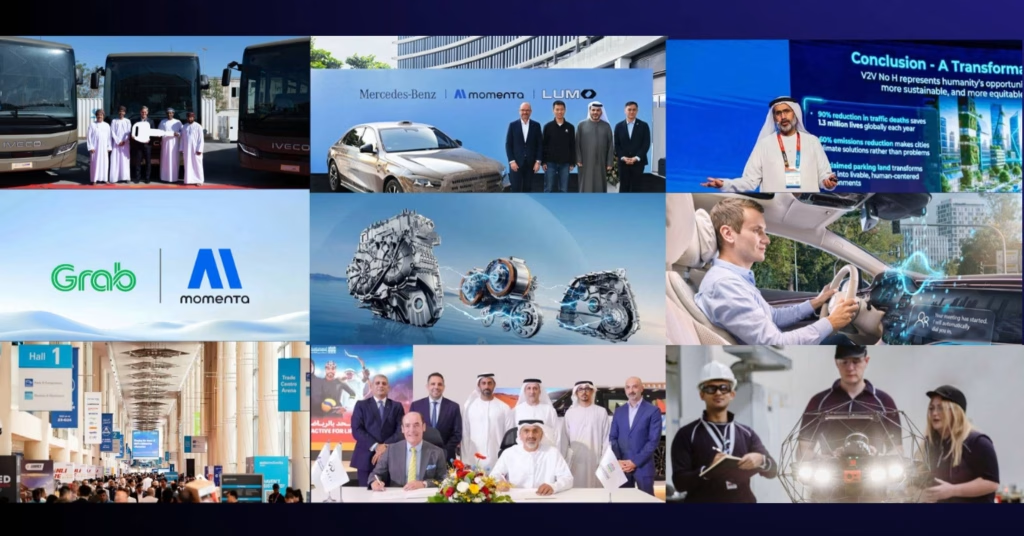
Introduction As the global automotive industry pushes deeper into 2026 planning cycles, momentum is concentrating around three forces: autonomy moving from pilots to scalable services, electrification strategies becoming more selective and market-specific, and software-defined platforms reshaping how value is created across the vehicle lifecycle. OEMs and suppliers are no longer competing on hardware alone—AI cockpits, digital services, battery circularity and data-driven operations are increasingly defining brand differentiation, margin protection and long-term customer loyalty. In parallel, the Middle East & Africa are evolving from adoption markets into active testbeds for next-generation mobility. From Dubai’s robotaxi progress and premium experience-led retail expansion, to Saudi Arabia’s accelerating electrification and talent-development agenda, the region is attracting global partnerships and investment across EV infrastructure, autonomy deployment and advanced aftermarket capability. This update captures the most important global and regional signals shaping the automotive landscape—where strategic alliances, regulatory direction and execution readiness will determine who leads the next phase of mobility transformation. Momenta, Grab Team Up to Scale Autonomous Driving in Southeast Asia Momenta and Grab announced a strategic partnership to accelerate autonomous driving deployment across Southeast Asia. Grab’s strategic investment in Momenta signals deeper integration beyond pilot programmes, reflecting Chinese autonomous-driving firms’ overseas expansion as domestic competition intensifies. For Grab, the partnership strengthens its long-term roadmap toward hybrid mobility models combining human, remote and autonomous operations. Bosch Targets €2bn in AI Cockpit Sales by 2030 Bosch set an ambition to generate €2bn in annual revenue from AI-enabled cockpit systems by 2030. The strategy focuses on intelligent, software-led in-car experiences as the cockpit becomes a central value battleground in software-defined vehicles. Rising OEM demand for scalable digital platforms underpins the shift toward recurring software and services revenue. Mercedes-Benz to Premiere All-Electric VLE in 2026 Mercedes-Benz confirmed the all-electric VLE will debut in March 2026, representing a flagship step in its electric van strategy. Premium MPVs and people-movers are gaining importance as Mercedes aims to assert leadership in electric vans. The launch will set future design and technology direction for the segment. BMW Opens Battery Recycling Centre in Bavaria BMW opened a battery recycling facility in Bavaria to support material recovery and circular-economy objectives. The centre strengthens supply-chain resilience as battery lifecycle responsibility gains regulatory focus. The move aligns sustainability goals with long-term industrial strategy. China Moves to Curb EV Price Wars Through Draft Regulatory Reforms Chinese regulators have drafted new rules aimed at ending aggressive EV price competition that has compressed margins across the industry. The proposals target unfair pricing practices and excessive discounting, signalling a shift from growth-at-all-costs toward sustainable profitability in the world’s largest EV market. Rivian Unveils In-House AI and Autonomy Technology Rivian revealed proprietary AI and autonomous-driving technology developed entirely in-house, reducing reliance on third-party suppliers and strengthening vertical integration. New hardware and software platforms will underpin future ADAS and autonomy features, with subscription-based services forming part of Rivian’s long-term revenue strategy. Lotus Confirms First Plug-In Hybrid Model for 2026 Lotus announced its first plug-in hybrid vehicle for launch in 2026, marking a shift from its earlier all-electric positioning. Hybrid technology is being introduced to broaden market appeal and flexibility, with China expected to play a key role in the rollout. Changan Reaches 30 Million Vehicle Production Milestone Changan achieved cumulative production of 30 million vehicles, reflecting decades of manufacturing growth and scale. Recent momentum has been driven by new-energy vehicles and technology-focused models, supporting ambitions for wider global expansion. Stellantis Deepens Partnership with Cox Automotive Across Europe Stellantis expanded its strategic collaboration with Cox Automotive to strengthen vehicle remarketing and digital services across Europe. The partnership supports efficiency, pricing accuracy and inventory optimisation, aligning with the group’s focus on operational excellence and margin protection. Audi Expands Premium Charging Hub Network in Düsseldorf Audi opened an additional high-power charging hub in Düsseldorf, combining rapid charging with premium customer amenities. Urban charging infrastructure remains critical to accelerating EV adoption, with premium charging experiences emerging as a competitive differentiator. Stellantis and Bolt Partner on Autonomous Vehicle Development Stellantis partnered with Bolt to advance autonomous vehicle deployment, focusing on testing and validation in urban mobility use cases. Ecosystem collaboration continues to play a central role in scaling autonomous technologies. Lexus Expands RZ Line-Up with F Sport Performance Variant Lexus expanded its RZ electric SUV range with the introduction of an F Sport Performance variant. The move enhances driving engagement while retaining premium positioning and broadening choice across power and performance levels. Hyundai Breaks Ground on Battery Research Facility Hyundai commenced construction of a major battery research facility, reinforcing its commitment to next-generation energy storage and deeper control over core EV technologies. The investment supports long-term electrification leadership and supply-chain security. JLR Trials Drones to Cut Factory Inspection Time JLR’s drone-based inspection trials significantly reduce factory-check durations while improving workplace safety. The initiative reflects a broader push toward digitised, automated manufacturing environments across factories and logistics operations. trinamiX Unveils Wide Field-of-View Dot Projector trinamiX introduced a wide-field dot projector enabling advanced 3D sensing for in-cabin monitoring, facial recognition and augmented-reality applications. The technology supports growing demand for enhanced safety and human–machine interaction. Regional Highlights: Middle East & Africa Binghatti and Mercedes-Benz Unveil Branded City Project in Dubai Binghatti and Mercedes-Benz unveiled plans for a Mercedes-Benz branded city in Dubai. The project represents a major step in branded real-estate evolution. It elevates automotive branding into lifestyle and urban development. Dubai remains a launchpad for luxury innovation. The project strengthens Mercedes-Benz’s brand extension strategy. Toyota Egypt Partners on Smart Storage Solutions Toyota Egypt signed a cooperation agreement for automated storage solutions. The partnership targets improved warehouse efficiency. Automation supports cost, speed and safety improvements. The move expands Toyota Egypt’s industrial solutions portfolio. Smart logistics demand continues to rise across the region. Al Jomaih and Shell Showcase Lubricant Innovation in Riyadh Al Jomaih and Shell highlighted lubricant technologies at the Riyadh Motor Show. The showcase focused on premium and advanced lubrication solutions. Aftersales categories are being positioned as mobility technology. The event aligned with Saudi Vision 2030 themes.
Mastering Customer Relationship Management: Essential KPIs for Automotive Dealers/Importers in MENA

In our new 9-part series covering essential KPIs for Dealers/Importers in the MENA region, we now explore Customer Relationship Management metrics—a critical framework that drives sustainable growth and profitability in today’s competitive Automotive landscape. While many dealerships implement CRM technology, truly successful operations understand that effective customer relationship management requires systematic measurement and optimisation across the entire customer journey. Lead Management Metrics: The Foundation of Sales Success The journey to exceptional CRM performance begins with effective lead management. These metrics evaluate how efficiently your dealership converts enquiries into sales opportunities: Lead Response Time: In today’s digital-first environment, speed is paramount. The average time taken to make first contact with a new lead directly impacts conversion potential. While industry benchmarks suggest responding within 30 minutes for digital leads, top-performing dealerships in the MENA region achieve under 15 minutes. Research conclusively demonstrates that lead conversion rates plummet by 80% when response time exceeds one hour. For Dealers/Importers in high-competition MENA markets like the UAE and Saudi Arabia, implementing automated response systems with personalised follow-up protocols helps maintain the human touch while improving speed. Lead Qualification Rate: This calculates the percentage of total leads qualified as genuine sales opportunities. Strong dealerships achieve 50-60% qualification rates. Lower rates signal issues with lead sources or qualification processes; higher rates indicate effective targeting and engagement. In MENA’s relationship-driven markets, qualification frameworks must balance efficiency with cultural sensitivity while evaluating purchase intention, timeframe, and financial capability. Lead-to-Appointment Ratio: This measures the percentage of qualified leads that convert into showroom appointments. Industry benchmarks target 40-50%. Top CRM teams in the region often exceed this by 5-10% through personalised WhatsApp communication and relationship-first dialogue. Appointment Show Rate: This reflects how many scheduled appointments actually arrive at the dealership. High-performing operations achieve 75-85% show rates through confirmation protocols and pre-appointment engagement. In the MENA region, multi-touch reminders and tailored visit motivations help overcome traffic and climate barriers. Customer Engagement Metrics: Building Lasting Relationships Beyond initial conversion, these KPIs evaluate ongoing customer engagement throughout the ownership lifecycle: Customer Contact Frequency: Successful dealerships maintain engagement every 45-60 days. In MENA markets, personalised WhatsApp messaging delivers 25-30% higher engagement rates than email. Structured communication calendars aligned with cultural norms ensure consistent touchpoints. Multi-Channel Engagement Rate: This tracks customer interaction across email (20-30%), SMS (40-50%), and social media (15-25%). The MENA region’s high mobile adoption requires channel strategies tailored to mobile-first behaviour and social media influence. Digital Customer Portal Usage: Increasing portal usage from 25-30% to 50%+ improves service retention by 15-20%. UAE and GCC customers respond strongly to mobile-first designs and Arabic language support. Customer Data Quality Index: Measures accuracy and completeness of CRM data. Top performers maintain 90%+ accuracy. Every 10% improvement boosts campaign effectiveness by 3-5%. Enhanced data governance ensures cultural appropriateness and reliability. Retention and Loyalty Metrics: Securing Long-Term Value These KPIs evaluate how well your CRM strategy transforms first-time buyers into lifetime customers: Customer Lifecycle Position: Tracking where each customer is in their ownership journey—warranty, finance term, replacement cycle—improves retention by 15-20%. Premium segments in MENA show even stronger returns from lifecycle-focused engagement. Customer Defection Early Warning: Predictive analytics flag declining service visits, negative feedback, or missed payments. Early action prevents 30-40% of potential defections. AI-enhanced models tailored to MENA behaviour patterns strengthen accuracy. Loyalty Programme Engagement: Fully engaged members spend 20-25% more annually and retain 30-35% longer. In MENA, experience-driven programmes outperform discount-based ones, especially those offering exclusivity and status recognition. Referral Generation Rate: Strong programmes generate 15-20% of leads and convert at 2x the rate of marketing-generated leads. Structured referral processes outperform passive referrals 3-4x. Word-of-mouth influence in MENA amplifies impact. CRM System Effectiveness: Operational Excellence Measures how efficiently CRM technology and processes support business goals: CRM Adoption Rate: Leading dealerships achieve 90%+ adoption through training, intuitive interfaces, and accountability. Every 10% improvement increases lead conversion effectiveness by 7-9%. Multilingual systems are essential for diverse MENA teams. Task Completion Rate: High-performing teams maintain 85-90% completion of CRM tasks and follow-ups. This KPI directly impacts nurturing effectiveness and customer satisfaction. CRM Activity-to-Result Ratio: Identifies which activities drive outcomes (appointments, sales, service bookings). Top performers require 20-25% fewer activities per sale through precise targeting and quality engagement. Automated Process Utilisation: Automating 60-70% of standard processes increases lead capacity by 30-40% without extra staff. MENA markets require balancing automation with high-touch relationship expectations. Cross-Departmental CRM Integration: Breaking Down Silos These KPIs measure how well CRM connects Sales, Service, and F&I: Sales-to-Service Handover Effectiveness: Integrated CRM processes increase first-service retention from 60-65% to 80-85%. In highly competitive MENA aftersales environments, this KPI is critical for long-term retention. Service-to-Sales Opportunity Conversion: Integrated CRM identifies 15-20% more sales opportunities from service, converting at up to 3x the rate of marketing leads. Advisor training and cultural sensitivity strengthen success. Finance Renewal Anticipation: Integrated CRM + F&I improves renewal rates by 20-25%. Region-specific processes help address unique customer expectations in MENA financial ecosystems. Regional Considerations for MENA Markets: Contextual Intelligence These metrics reflect unique characteristics of the MENA retail environment: Seasonal Communication Adaptation: Adjusting outreach during travel-heavy months increases engagement by 25-30%. Mobile-friendly formats perform strongly in summer. Cultural Celebration Integration: CRM programmes aligned with Ramadan, Eid, and National Days increase engagement by 20-25%. Automated calendars ensure relevance and timing. VIP Customer Management: Dedicated relationship protocols for high-net-worth customers boost retention by 30-40% and lifetime value by 2-3x. Expatriate Customer Tracking: Tracking residency status helps anticipate replacements and trade-ins, increasing opportunities by 25-30%. Tailored processes support diverse expatriate needs. Implementing Effective CRM Performance Management Based on extensive work with leading Dealers/Importers across the region: 1. Establish clear baseline metrics across all CRM dimensions. 2. Develop regionally-calibrated benchmarks that reflect market realities. 3. Implement integrated dashboards with real-time visibility for all levels. 4. Create accountability frameworks defining ownership of each metric. 5. Foster continuous improvement through structured reviews and root cause analysis. By systematically monitoring and optimising these CRM KPIs, Dealers/Importers across the MENA region can enhance customer acquisition, increase retention, and build long-term competitive
Global and MENA Automotive Industry November Update 2025: EVs, Autonomy & Software-Defined Mobility
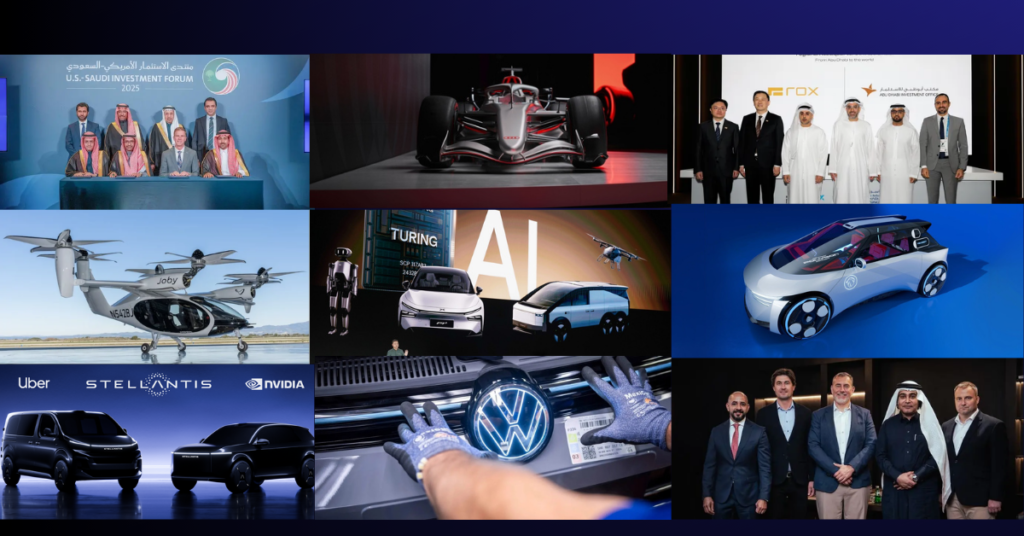
Global and MENA Auto Outlook: Next-Gen EVs, Smart Mobility Systems & Autonomous Technology Introduction From Disney streaming in Audi cabins and Lamborghini’s 1,000+ hp hybrid supercars, to Jeep’s new turbocharged Grand Cherokee and GM’s next-generation V8s, this edition captures a global automotive industry balancing emotional performance with hard-headed efficiency. Global OEMs are doubling down on software-defined vehicles, autonomy and new cockpit experiences, while still investing in combustion and hybrid technologies that will carry many markets through the transition. Alongside this, the next wave of mobility infrastructure is taking shape: Waymo’s robotaxis expanding across US cities, Stellantis partnering with NVIDIA and Uber on Level 4 ride-hailing, XPENG blending robotaxis with flying cars, and LG Chem with ZEISS designing holographic windscreens for tomorrow’s digital cockpit. In parallel, regional players across the Middle East and Africa are moving from observers to orchestrators—Abu Dhabi scaling AV and eVTOL ecosystems, Saudi Arabia and Oman advancing local manufacturing, and markets like South Africa, Egypt and Qatar emerging as serious hubs for new-energy vehicles, logistics innovation and Chinese-brand expansion. Audi Integrates Disney Streaming into Vehicle Systems Audi introduces Disney’s streaming services into its in-vehicle infotainment systems. The integration enhances cabin entertainment as digital experiences become central to modern mobility and connected-car value. It reflects shifting consumer expectations, particularly among younger and digitally connected users. Audi aims to differentiate its vehicles through richer content and seamless user interaction. The move shows how infotainment partnerships are becoming strategic in the premium segment and in software-defined-vehicle positioning. Alfa Romeo Displays the 33 Stradale at the L.A. Auto Show The showcase of the 33 Stradale reinforces Alfa Romeo’s heritage narrative and brand identity in a key global market. Its presence builds excitement around the brand’s performance direction and electrified future. The display supports Alfa Romeo’s ambition to strengthen its premium credentials in the United States. The reveal comes as the brand prepares further strategic announcements. It contributes to Alfa Romeo’s ongoing push toward renewed global relevance. Waymo’s “Whirlwind 2025” Expands into Three New US Cities Waymo’s Whirlwind 2025 initiative continues with launches in three additional US cities, extending its autonomous-mobility footprint. The expansion signals growing confidence in operational maturity and regulatory acceptance for autonomous mobility services. As well as enhancing scale, the city roll-out helps Waymo capture new passenger segments and data-rich urban-driving environments. For MENA stakeholders, the move provides insight into how future mobility services might evolve locally and the readiness of cities to support them. The development emphasises how auto companies and mobility-tech firms are increasingly overlapping as part of broader ecosystem shifts. Nio Reportedly Licenses Out Its AV Chip Technology Nio has begun licensing its in-house developed Shenji NX9031 autonomous-driving chip technology to third-party automotive semiconductor firms. The move transforms a high-cost research project into a potential revenue stream and strengthens Nio’s tech positioning. Industry sources suggest contract values vary significantly depending on the depth of the licensing agreement. The chip supports next-generation AD capabilities and is built on a 5-nm automotive-grade process. The shift illustrates how EV makers are monetising internal technology assets beyond vehicle sales. GM Prepares New Small-Block V8s (5.7L & 6.6L) Amid Powertrain Shift General Motors is developing a new generation of small-block V8 engines in 5.7-litre and 6.6-litre configurations. The 5.7-litre unit is set to support mainstream models such as the Chevrolet Silverado 1500, offering improved efficiency over existing V8 engines. The larger 6.6-litre version is intended for high-performance applications, including the forthcoming Corvette Grand Sport, underscoring GM’s continued focus on powerful combustion technology. This development is part of a significant investment aimed at sustaining V8 capability while the company advances its electrification strategy. Although GM has confirmed the next-generation small-block family, detailed specifications and model allocations remain unannounced. Audi Unveils Design Concept for Its Formula 1 Entry Audi has revealed the design identity for its 2026 Formula 1 contender, signalling a key milestone in its debut into the championship. The concept showcases a blend of technical precision and emotional design consistent with Audi’s brand language. This marks a significant investment in motorsport as a global technology and brand-building platform. Audi’s entry aligns with the sport’s new regulatory era focusing on hybrid efficiency and sustainable performance. The reveal strengthens Audi’s long-term strategy to elevate global visibility through top-tier motorsport. Ford Expands BlueCruise Availability to Additional Models Ford will extend its BlueCruise hands-free driving system to four additional models, broadening access to advanced driver-assistance technology. The announcement reflects the growing mainstream demand for semi-autonomous driving features. The expansion builds on Ford’s increasing adoption of software-driven vehicle updates and connected services. BlueCruise is positioned as a key differentiator in long-distance comfort and driver-assistance convenience. This development highlights the accelerating pace of ADAS integration across global vehicle portfolios. Ferrari Honours Eight Suppliers at 2025 Podio Ceremony Ferrari awarded eight of its international suppliers at the 2025 “Podio Ferrari” event, recognising excellence in technological innovation and long-term collaboration. The awards ceremony featured 16 finalists selected from over 700 of the company’s strategic partners across six categories, reflecting Ferrari’s emphasis on performance, sustainability and quality in its global supply chain. 2026 Jeep Grand Cherokee Debuts Turbocharged Four-Cylinder Engine The 2026 Grand Cherokee enters its mid-cycle refresh with a new 2.0-litre turbocharged “Hurricane 4” engine delivering around 324 hp, replacing the outgoing V6. The model features refined exterior styling and an upgraded 12.3-inch infotainment system. Jeep continues to offer the 4xe plug-in hybrid variant as part of the updated line-up, reflecting Stellantis’ strategy to balance performance with emissions efficiency. The new engine enhances both fuel economy and responsiveness, positioning Jeep strongly in the competitive SUV segment. The update also reinforces Jeep’s appeal in markets prioritising capability and environmental responsibility. Lamborghini Unveils Fenomeno and Revuelto at Tokyo Event Lamborghini showcased the Fenomeno and a bespoke Revuelto Ad Personam at Lamborghini Day Japan, celebrating the brand’s growing presence in Asia. The Fenomeno, an ultra-limited production model with a 1080-hp hybrid system, exemplifies Lamborghini’s commitment to blending extreme performance with electrification. The event underscored the marque’s focus on exclusivity,
Driving Financial Excellence: Essential Executive KPIs for Automotive Dealers/Importers in MENA

In our new 8-part series covering essential KPIs for Dealers/Importers in the MENA region, we now focus on Executive Financial metrics—the high-level indicators that provide leadership with a holistic view of dealership performance. While departmental KPIs focus on operational details, executive financial metrics offer a broader perspective on overall business health and sustainability. For Automotive Dealers/Importers across the MENA region, who often manage complex, multi-faceted businesses in diverse market environments, having clear visibility of these financial indicators is essential for strategic decision-making. This article explores the key financial KPIs that executives should monitor to drive profitable growth and business sustainability in the unique context of MENA markets. Profitability Metrics: Measuring Overall Financial Performance Profitability metrics provide fundamental insights into business health: Return on Assets (ROA): This measures how efficiently the dealership is using its assets to generate profit, calculated by dividing net income by total assets. Industry benchmarks typically range from 5-8% for well-performing dealerships. This comprehensive metric helps executives assess overall operational efficiency and asset utilisation across all departments. In capital-intensive MENA markets, where real estate and facility investments often represent significant portions of total assets, optimising ROA requires careful balance of asset utilisation and market presence. Return on Investment (ROI): This calculates the return generated relative to the capital invested in the dealership, showing how effectively management is using invested capital. Dealers often target 15-20% ROI. This is particularly important for dealer groups and investors comparing performance across multiple stores or considering new acquisitions. In rapidly developing MENA markets, ROI expectations may need adjustment based on market maturity and growth potential. EBITDA: This measures operational profitability before accounting for non-operational expenses. For dealerships, EBITDA typically ranges from 2-4% of total revenue. Many dealer groups and potential buyers evaluate dealerships based primarily on EBITDA multiples, making this a critical valuation metric. For businesses operating across multiple MENA countries, comparing EBITDA performance against market-specific benchmarks provides valuable insights into relative performance. Net Profit Margin: This shows the percentage of revenue that translates to bottom-line profit after all expenses. Industry averages range from 10-12% for new vehicle dealers. While seemingly small, this margin represents significant dollars on high-volume sales and helps executives compare performance across different-sized operations. In price-sensitive MENA markets, maintaining healthy margins while remaining competitive requires sophisticated pricing and cost control strategies. Departmental Contribution: This breaks down profit contribution by department (new vehicles, used vehicles, service, parts, F&I). Well-structured dealerships typically see 30-40% from fixed operations, 30-35% from F&I, and the remainder from vehicle sales. This breakdown helps executives identify underperforming areas and allocation opportunities. Understanding the unique departmental contribution mix in specific MENA markets helps executives evaluate performance against regional benchmarks. Liquidity and Cash Flow Metrics: Ensuring Financial Stability Liquidity metrics help assess the dealership’s ability to meet financial obligations: Current Ratio: This measures short-term liquidity by dividing current assets by current liabilities. Healthy dealerships maintain ratios between 1.5 and 2.0. Lower ratios may indicate potential cash flow problems, while significantly higher ratios might suggest inefficient asset utilisation. In MENA markets with longer supply chains and potential payment delays, maintaining appropriate liquidity buffers is essential for stability. Quick Ratio (Acid Test): This provides a stricter liquidity measure by excluding inventory from current assets. Dealers typically maintain quick ratios around 1.0-1.2. Given the capital tied up in inventory, this metric offers executives a clearer picture of immediate liquidity without relying on inventory liquidation. In markets with longer turnover cycles, this ratio provides essential insights into true liquidity position. Operating Cash Flow: This tracks the cash generated from core operations. Strong dealerships generate consistent positive operating cash flow that exceeds net income due to non-cash expenses. In seasonally variable MENA markets, monitoring trends against historical patterns helps identify cash flow issues early. Days Cash on Hand: This calculates how many days the dealership could operate using available cash. Industry benchmarks suggest 30-45 days as a healthy target. In volatile or seasonal markets, maintaining adequate reserves ensures business continuity. Floor Plan Aging: This monitors the age of inventory financed through floor plan credit lines. Well-managed dealerships maintain 70% of inventory under 60 days old. Extended aging increases carrying costs and risk. In MENA markets with longer supply chains, balancing inventory freshness with selection requires sophisticated management. Operational Efficiency Metrics: Optimising Resource Utilisation Efficiency metrics help identify opportunities to improve productivity: Expense-to-Revenue Ratio: This measures operating expenses as a percentage of total revenue. Industry benchmarks target 11-13%. Breaking this down by expense category helps identify cost control opportunities. In high-cost MENA markets, maintaining competitive ratios requires ongoing optimisation. Personnel Expense as Percentage of Gross Profit: This calculates total personnel costs relative to gross profit. Industry standards suggest 45-50%. As the largest controllable expense, this metric deserves close executive attention. Labour costs vary widely across MENA markets, making local benchmarking essential. Inventory Turnover Rate: This measures how quickly inventory is sold and replaced. New vehicles target 6-8 turns annually, used vehicles 12+. Faster turnover reduces carrying costs and depreciation risk. In markets with long supply chains, optimising turnover requires strategic planning. Days Supply of Inventory: This calculates how long current inventory would last at current sales rates. Targets suggest 45-60 days for new vehicles and 30-45 for used. Excessive supply ties up capital, while insufficient supply limits sales. MENA markets often face import delays, making supply balance critical. Fixed Coverage Ratio (Absorption Rate): This measures what percentage of fixed expenses are covered by gross profit from fixed operations. Dealers target 85-100% for stability during sales downturns. In seasonal MENA markets, strong absorption is essential for resilience. Growth and Market Performance Metrics: Measuring Business Development Growth metrics help evaluate business expansion and competitive position: Sales Growth: This tracks year-over-year revenue growth for established locations. Healthy dealerships target 5-10%. In rapidly developing MENA markets, growth expectations should reflect market maturity and potential. Market Share Trend: This monitors changes in the dealership’s share of total market sales. Tracking both absolute and relative share helps executives evaluate competitive strength. Customer Lifetime Value (CLV): This calculates total
Maximising F&I Performance: Essential KPIs for Automotive Dealers/Importers in MENA

In our new 8-part series covering essential KPIs for Dealers/Importers in the MENA region, we now turn our attention to the Finance & Insurance (F&I) department—often referred to as the dealership’s most profitable square metres. The F&I department has evolved from a simple paperwork processor to a critical profit centre for Automotive businesses across the MENA region. As vehicle margins continue to face pressure, F&I performance has become increasingly vital to overall dealership profitability. To optimise this crucial department, Dealers/Importers need to implement and monitor the right Key Performance Indicators (KPIs). This article explores the essential F&I metrics that drive profitability, efficiency, and compliance in the unique MENA Automotive market. Product Penetration Metrics: Maximising Revenue Opportunities Product penetration metrics measure how effectively your F&I department sells additional products and services to vehicle buyers: Finance Penetration Rate: This fundamental metric measures the percentage of vehicle sales financed through your dealership rather than outside financing or cash purchases. In the MENA region, where banking relationships and finance options vary significantly between markets, monitoring this rate is particularly important. Industry benchmarks typically target 70-80% for new vehicles and 60-70% for used vehicles. Higher rates indicate effective finance department performance and significant profit opportunity. Top performers focus on offering competitive rates and building relationships with multiple lenders to accommodate various customer credit profiles specific to regional markets. Service Contract Penetration: This tracks the percentage of vehicles sold with extended service contracts or warranties. In the harsh environmental conditions prevalent across much of the MENA region (extreme heat, dust, etc.), these products offer genuine value to customers while providing substantial profit to dealerships. Industry averages range from 40-45%, while top performers achieve 55%+ penetration. These products typically generate $800-1,200 in profit per contract, making them crucial to F&I department profitability. Effective presentation of the value proposition based on vehicle reliability data and region-specific repair cost analysis improves this metric. GAP Insurance Penetration: This measures the percentage of financed vehicles sold with Guaranteed Asset Protection insurance. Industry benchmarks range from 20-30%, with higher rates for longer-term loans and vehicles with faster depreciation. In MENA markets, where insurance requirements and regulations differ significantly between countries, having market-specific knowledge of insurance products and regulations is essential for maximising appropriate penetration. Vehicle Protection Products Penetration: This tracks the sale of protection packages, theft deterrent systems, and other vehicle protection products as a percentage of total sales. The extreme climate conditions in many MENA markets make protection products particularly valuable, and well-performing F&I departments achieve 25-35% penetration across these products. Product bundling strategies often improve overall penetration rates. Financial Performance Metrics: Measuring Profitability Financial metrics reveal the true contribution of your F&I department to overall dealership profitability: Average F&I Income Per Vehicle Retailed (PVR): This calculates the total F&I department income divided by the number of vehicles sold. Industry benchmarks range from $1,200-1,500 for mainstream brands and $1,800-2,200 for luxury brands, though these figures can vary significantly across different MENA markets. Top performers may exceed $2,500 PVR. This comprehensive metric reflects overall F&I effectiveness and is often tied to management compensation. Product Gross Profit: This tracks the profit generated from the sale of F&I products. It’s typically broken down by product type to identify the most profitable offerings. Understanding product profitability helps F&I managers focus on high-margin products that also provide genuine customer value, especially those that address region-specific concerns like extreme heat protection or extended parts availability. F&I Department Contribution: This measures the net profit contribution of the F&I department after all direct expenses. As front-end margins on vehicle sales continue to compress, F&I contribution has become increasingly vital to overall dealership profitability, often accounting for 30-40% of total dealership profit. In luxury-oriented markets like the UAE, this contribution can be even higher. Average Products Per Deal: This tracks the average number of F&I products sold per vehicle transaction. Industry benchmarks range from 1.5-2.0 products per deal, while top performers achieve 2.5+ on average. This metric helps identify opportunities for appropriate product packaging and presentation improvements. In the relationship-focused business culture of the MENA region, building trust is essential for multi-product sales success. Operational Efficiency Metrics: Streamlining Processes Efficiency metrics help identify bottlenecks and opportunities to improve the customer experience while maximising profitability: F&I Deals Per Manager: This tracks the number of deals processed per F&I manager per month. Efficient departments handle 80-100+ deals per manager monthly. This metric helps determine appropriate staffing levels and identifies process bottlenecks. In markets with highly seasonal sales patterns, like those affected by summer heat or seasonal religious observances, this metric may fluctuate significantly throughout the year. Contract Approval Rate: This measures the percentage of finance applications approved by lenders. Lower approval rates indicate either customer credit quality issues or insufficient lender relationships. Well-performing F&I departments maintain relationships with 15-20+ lenders to accommodate various credit profiles. In MENA markets where banking regulations and credit reporting infrastructure vary significantly between countries, understanding local lending parameters is crucial for maximising approvals. First Pass Funding Rate: This tracks the percentage of contracts funded by lenders on first submission without requiring corrections or additional documentation. Higher rates (target: 90%+) indicate efficient processes and proper documentation practices. Low rates create cash flow delays and necessitate contract rewrites that damage customer experience. In markets with more complex documentation requirements, maintaining high first-pass rates requires meticulous attention to detail and strong lender relationships. Compliance and Risk Metrics: Protecting Your Business In the diverse regulatory environments across MENA markets, compliance metrics are essential for managing risk: Compliance Audit Scores: This measures performance on internal and external compliance audits examining adherence to regional regulatory frameworks. In MENA markets, this includes compliance with country-specific consumer protection laws, financial services regulations, data protection requirements, and tax compliance. Regulations vary significantly across MENA countries, with GCC nations typically having more formalised regulatory structures. Top dealerships conduct regular internal audits aligned with local regulatory requirements and maintain detailed documentation of compliance practices specific to each market they operate in. Rate Markup Distribution: This analysis examines
Driving Automotive Marketing Performance: Essential KPIs for Dealers/Importers in MENA

In our new 8-part series covering essential KPIs for Dealers/Importers in the MENA region, we now focus on Marketing—a critical function that drives dealership growth and customer acquisition. The Automotive marketing landscape has undergone dramatic transformation in recent years, particularly across MENA markets where digital adoption has accelerated rapidly. Today’s successful Dealers/Importers must balance traditional marketing approaches with sophisticated digital strategies to reach customers effectively in this evolving environment. This article explores the key performance indicators that drive marketing excellence for Automotive retail operations in the unique context of MENA markets. Digital Marketing Metrics: Maximising Online Effectiveness Digital metrics help quantify the performance of your online marketing initiatives: Website Traffic: This measures the total number of visitors to your dealership website. Beyond raw visitor count, it’s valuable to segment this by traffic source (organic search, paid search, social media, direct). Most dealerships aim for consistent month-over-month growth. Modern dealerships typically track this through Google Analytics or similar platforms, looking at metrics like average time on site and bounce rate alongside total visitors. In MENA markets, where mobile usage often exceeds global averages, paying particular attention to mobile traffic performance is essential. Lead Conversion Rate: This calculates the percentage of website visitors who take a desired action such as submitting a contact form, requesting a quote, or scheduling a test drive. Industry benchmarks typically range from 1.5% to 3% for dealership websites. Optimising landing pages, forms, and calls-to-action can significantly improve this metric. In the MENA region, where customer service expectations are often high, ensuring rapid response to digital leads directly impacts conversion success. Cost Per Lead (CPL): This measures how much your dealership spends on marketing to generate each new lead. It’s calculated by dividing total marketing spend by the number of leads generated. Automotive industry averages range from $25-$45 per lead, though this varies by market and vehicle segment. Lower CPL indicates more efficient marketing spend. In diverse MENA markets, CPL can vary significantly between countries and should be benchmarked against local standards. Search Engine Rankings: This tracks where your dealership appears in search results for relevant keywords like “[brand] dealer [city]” or “new cars [city].” First-page rankings, particularly in the top three positions, dramatically increase visibility and traffic. Many dealerships invest in SEO and local search optimisation to improve these rankings. In the MENA region, optimising for both English and Arabic search terms (where relevant) is essential for maximum market penetration. Pay-Per-Click (PPC) Performance: This measures the effectiveness of paid search advertising, including metrics like click-through rate (CTR), cost per click (CPC), and conversion rate. Automotive industry CTR averages range from 1.5% to 3.5% for search ads. Effective keyword targeting and ad copy can significantly improve these metrics. In multilingual MENA markets, testing ad performance across different languages and cultural contexts often yields substantial performance improvements. Social Media and Reputation Metrics: Building Your Digital Brand These metrics help evaluate your dealership’s online presence and customer perception: Social Media Engagement Rate: This measures how actively your audience interacts with your social media content through likes, comments, shares, and clicks. Engagement rates of 1-3% are considered good in the Automotive industry. Content featuring actual customers, behind-the-scenes dealership stories, and new model reveals typically generate the highest engagement. In the relationship-focused MENA markets, authentic engagement often drives higher conversion than purely promotional content. Online Review Metrics: This tracks both the quantity and quality of reviews across platforms like Google, Facebook, and regional platforms such as Yallamotor, Dubizzle, and Opensooq. The average star rating (aim for 4.5+ stars) and review response rate (target 100%) are particularly important as they directly influence consumer purchase decisions. Regional consumer research indicates that over 80% of MENA Automotive customers consult online reviews before visiting a dealership, with particular emphasis on Arabic-language reviews for localised customer experiences. Social Reach and Audience Growth: This measures the size of your social media audience and how quickly it’s growing. While raw follower counts matter less than engagement, consistent growth indicates effective content strategy. Many dealerships track month-over-month follower growth rates across platforms. In MENA markets, where social media usage rates are among the highest globally, building social presence is particularly valuable for brand development. Share of Voice:This measures how much your dealership dominates the conversation in your market compared to competitors. It can be calculated by analysing mentions across social media, news, and review sites relative to competitors. Higher share of voice typically correlates with stronger brand awareness. In competitive MENA metropolitan markets like Dubai, Riyadh or Cairo, tracking share of voice helps gauge marketing effectiveness against well-funded competitors. Traditional Marketing Metrics: Measuring Offline Performance Despite digital growth, traditional marketing remains important in many MENA markets: Marketing Return on Investment (ROI): This calculates the return generated from marketing investments, measured by attributing sales and gross profit to specific marketing channels and campaigns. Sophisticated dealerships track ROI by marketing channel to optimise their marketing mix. Industry leaders aim for 3:1 or higher ROI on marketing spend. In the diverse MENA region, ROI can vary significantly by market channel and should be measured against localised benchmarks. Walk-in Traffic: This counts the number of customers who physically visit the dealership, often tracked through customer relationship management (CRM) systems. While digital leads are important, many customers still prefer to walk in, making this a vital metric. Dealerships typically track traffic patterns by day of week and time of day to optimise staffing. In many MENA markets where shopping malls remain cultural hubs, dealerships with mall locations or showrooms often measure specific metrics related to mall foot traffic conversion. Marketing Campaign Response Rate: This measures the percentage of recipients who respond to direct marketing efforts like mail, email, or SMS campaigns. Industry averages range from 0.5% to 2% for direct mail and 10-15% for email campaigns to existing customers. Higher response rates indicate more relevant messaging and offers. In MENA markets, where SMS open rates often exceed 95%, SMS marketing frequently outperforms email for immediate response campaigns. Cost Per Sale/Acquisition (CPA): This calculates the
Automotive Sales Mastery: Series 8: The Core Traits and Mindset of Exceptional Salespeople

Success in Automotive sales stems from a unique combination of skills, mindset, and behaviours. Technical knowledge and negotiation skills are essential, but the real differentiator is the salesperson’s attitude, self-belief, and motivation. In this comprehensive guide, we delve into the qualities, behaviours, and mindset that define top-performing salespeople in the MENA Automotive market, combining the principles of psychology, self-talk, and motivation. The Archetypes of Salespeople Salespeople typically fall into one of three categories, each with its strengths and potential pitfalls: 1.The Relationship Builder: Strengths: Builds trust and long-term relationships, excels in understanding customer needs. Challenge: May struggle to push for a close due to an overemphasis on empathy. 2.The Challenger: Strengths: Thrives on questioning assumptions and educating customers with confidence. Challenge: Can come across as overly assertive if not balanced with tact. 3.The Problem Solver: Strengths: Expert at addressing customer pain points with tailored solutions. Challenge: May get lost in details, missing broader opportunities. Qualities of Top Salespeople The most successful salespeople combine technical expertise with interpersonal mastery. Key qualities include: Persistence: A relentless drive to achieve goals despite challenges. Empathy: Understanding and addressing customer emotions and needs. Amiability: Being approachable and friendly, which fosters trust. Focus: Maintaining goal-oriented behaviour and staying organised. Product and People Knowledge: Mastering technical details and building rapport effectively. The Role of Attitude in Sales Attitude often outweighs skill in determining success. Here’s how a positive attitude enhances performance: Energy Transference: Customers pick up on enthusiasm and positivity, shaping their experience. Resilience: A strong attitude helps bounce back from rejection and maintain motivation. Consistency: Staying positive ensures peak performance, even during challenges. The Power of Self-Belief and Motivation Motivation and belief in one’s abilities are essential for overcoming obstacles and achieving targets. Strategies to cultivate these qualities include: Focus on Activity, Not Just Results: Breaking the sales process into manageable stages ensures consistent effort. For instance: * Engaging more customers increases the likelihood of closing deals. * Viewing each interaction as an opportunity helps maintain motivation, even without immediate results. Set Clear Goals: Define specific, actionable targets and align daily activities with long-term objectives. Clear goals foster purpose and focus. Draw Inspiration from Success Stories: Take cues from figures like Steve Jobs, whose persistence in creating Apple epitomises the power of self-belief and resilience. Visualise Success: Imagine achieving monthly sales targets and the rewards that follow. Visualisation reinforces confidence and inspires action. Find Purpose in Your Work: Purpose-driven goals, such as enhancing a customer’s life with the right vehicle, provide deeper meaning to daily tasks. Harnessing the Power of Self-Talk Self-talk directly influences performance. Reframing negative thoughts into empowering affirmations builds confidence and resilience: * Replace “I can’t close this deal” with “I’ve prepared well and will give my best effort.” * Avoid pre-judging customers based on superficial impressions. * Use affirmations like: “I am capable of exceeding my targets” to reinforce positive beliefs. The Cycle of Positive Self-Talk The “Self-Talk Cycle” shows how thoughts influence actions and results: * Positive Thoughts → Confident Actions → Positive Results → Reinforced Beliefs. Breaking negative cycles early by reframing thoughts prevents underperformance. Strategies to Cultivate a Winning Mindset Celebrate Small Wins: Recognising progress boosts morale and motivation. Stay Present: Focus on controllable factors in the moment rather than dwelling on failures or uncertainties. Surround Yourself with Positivity: Engage with supportive mentors, peers, or inspirational materials. Persist Through Challenges: Learn from setbacks and view them as growth opportunities. Commit to Lifelong Learning: Embrace adaptability and continuous improvement in an ever-evolving market. Conclusion Exceptional salespeople embody a blend of positive attitude, motivation, and belief in their abilities. By combining technical skills with psychological strategies, they build trust, drive results, and navigate cultural nuances in the MENA market. Success in Automotive sales begins with the right mindset—a journey that AMENA is here to support. AMENA’s Commitment to Sales Excellence At AMENA, we empower OEMs and Dealers/Importers with tailored tools and training to build high-performing sales teams. From fostering motivation to mastering advanced sales strategies, we help you achieve exceptional results. Visit www.amenaauto.me to transform your sales potential today. Contact Us Today! office@amenaauto.me Follow us @ Linkedin | Youtube| Instagram | Facebook We express our sincere gratitude to all the veterans and experienced professionals in the automotive industry for their valuable input and advice when we write our articles. We take pride in our commitment to embracing technology, including AI, to enhance the quality of our articles.
Automotive Sales Mastery: Series 7: Understanding Sales Psychology

In the world of Automotive sales, success isn’t just about product knowledge or negotiation skills; it’s about understanding the psychology behind buying decisions. Why do customers choose one car over another? What influences their emotional and logical thought processes? This article explores the critical role of sales psychology and offers actionable insights for mastering the art of influence in the MENA region. The Dual Minds of a Customer Human decision-making is guided by two key components: the conscious mind and the subconscious mind. Understanding how these interact can help sales professionals navigate the sales process more effectively: Conscious Mind (Logical): Processes facts and data, such as price, fuel efficiency, and features. Subconscious Mind (Emotional): Influenced by feelings, gut instincts, and personal desires. For instance, customers may justify a luxury car purchase with logical reasons like safety or resale value, but the true motivator is often emotional—the status, excitement, or pride it brings. The Four Stages of Buying and Learning Sales psychology aligns closely with the stages of learning, which mirror the buying process: Unconscious Incompetence: Customers are unaware of their needs. Conscious Incompetence: They recognise their needs but lack clarity on solutions. Conscious Competence: They evaluate options and begin making decisions. Unconscious Competence: They instinctively move forward with a choice. As a salesperson, your role is to seamlessly guide customers through these stages and address their conscious and subconscious concerns. Techniques to Influence the Subconscious Mind Subliminal Conditioning: While direct subliminal advertising is no longer permissible, the principles of subtle suggestion remain effective. For instance: * Use evocative language and imagery: “Imagine yourself cruising down Sheikh Zayed Road in this sleek, all-electric sedan.” * Frame options positively: Instead of asking, “Would you like a small or large warranty?” say, “Would you prefer the comprehensive or premium coverage?” Emotional Anchoring: Tap into the customer’s emotions by creating memorable moments during the sales process: * Highlight features that resonate emotionally, such as family safety or advanced technology. * Use stories to illustrate benefits, e.g., “One of our customers shared how the adaptive cruise control saved them during a long drive.” Subtle Visual Cues: Visual presentation influences subconscious perceptions * Showcase cars in pristine, well-lit environments. * Use colours and design elements that evoke trust and sophistication. Avoiding Psychological Traps Don’t Overwhelm the Customer: Too many options or excessive information can lead to decision fatigue. Simplify choices. Avoid Negative Framing: Highlight benefits rather than deficiencies. Instead of, “This model doesn’t have an extended warranty,” say, “This model comes with a comprehensive three-year warranty.” Steer Clear of Manipulation: Building trust requires authenticity. Focus on aligning solutions with customer needs rather than pushing unnecessary features. The Role of Sales Conditioning Subtle conditioning techniques can nudge customers toward favourable decisions: Priming: Leave positive impressions by mentioning high-value aspects frequently. For instance, “This EV model has been a top choice for professionals in Dubai.” Parameter Setting: Guide counteroffers by suggesting ranges. For example, “We typically see trade-ins in the range of AED 80,000 to AED 85,000 for cars like yours.” Conclusion Sales psychology is an essential skill in today’s competitive Automotive market. By understanding and leveraging the interplay between logic and emotion, sales professionals can build trust, inspire confidence, and guide customers toward making decisions they feel good about. AMENA’s Commitment to Automotive Sales Excellence At AMENA, we empower OEMs and Dealers/Importers with cutting-edge strategies that harness the power of sales psychology. From training on customer engagement to mastering influence techniques, we help you drive results and build lasting relationships. Visit this page to elevate your sales expertise. Contact Us Today! office@amenaauto.me Follow us @ Linkedin | Youtube| Instagram | Facebook We express our sincere gratitude to all the veterans and experienced professionals in the automotive industry for their valuable input and advice when we write our articles. We take pride in our commitment to embracing technology, including AI, to enhance the quality of our articles.
Automotive Sales Mastery: Series 6: Closing (Sealing the Deal with Confidence) and Follow-Up

Closing a sale is the culmination of all your efforts throughout the sales process. It’s the moment of truth, where trust, rapport, and negotiation come together. In the MENA Automotive market, where customer expectations are high, closing effectively requires strategy, empathy, and impeccable timing. This article explores the best practices and techniques for mastering the art of closing. Understanding the Importance of Closing Closing isn’t just about getting a signature; it’s about ensuring the customer feels confident and satisfied with their decision. A successful close: 1. Confirms Commitment: Solidifies the customer’s decision to purchase. 2. Eliminates Doubts: Reassures the customer by addressing lingering concerns. 3. Strengthens Relationships: Leaves a positive impression that fosters loyalty. Best Practices for Closing the Sale Recognise Buying Signals: * Pay attention to verbal and non-verbal cues such as repeated compliments about the car, inquiring about financing, or discussing delivery dates. Choose the Right Closing Technique: * Assumptive Close: Proceed as if the customer has already decided. For example, “Shall we finalise the paperwork?” * Alternative Choice Close: Offer two positive options. For instance, “Would you prefer the standard package or the deluxe package?” * Summary Close: Recap the car’s benefits and how they align with the customer’s needs. “You mentioned safety and comfort were priorities, and this model excels in both. Shall we proceed?” Address Objections Before Closing: * If objections arise, handle them confidently and empathetically. Use techniques like the “what if” strategy to resolve concerns. For example, “What if we include a complimentary maintenance package?” Create Urgency Without Pressure: * Highlight time-sensitive promotions or limited inventory subtly. For example, “This colour is in high demand and may not be available for long.” Reinforce the Decision: * Once the customer agrees, celebrate their choice. Say, “Congratulations! You’ve made an excellent decision.” This affirmation builds confidence and excitement. Avoiding Common Closing Mistakes Don’t Rush: Allow the customer to arrive at their decision naturally. Avoid Overloading Information: Keep the focus on key benefits rather than introducing new details at the last moment. Don’t Neglect Post-Close Engagement: Ensure the customer feels valued even after signing. Follow-Up – Turning Sales into Loyalty The follow-up stage is where exceptional salesmanship truly shines. It’s an opportunity to reinforce the customer’s decision, address any post-purchase concerns, and nurture a lasting relationship. Why Follow-Up Matters Follow-up is critical for: Enhancing Customer Satisfaction: Ensures the customer’s experience remains positive after the sale. Building Long-Term Loyalty: Keeps your dealership top-of-mind for future purchases. Driving Referrals: Satisfied customers are more likely to recommend your services. Effective Follow-Up Strategies The Immediate Follow-Up Call: * Contact the customer within 24 hours of the sale. Use this opportunity to thank them and confirm their satisfaction. * Example: “Hi, I just wanted to thank you again for your purchase and ensure everything is in order. Is there anything else you’d like to discuss?” Provide Additional Information: * Share helpful resources like user manuals, warranty details, or tips on optimising their new car’s features. * Example: “I realised I forgot to mention how to set up the infotainment system. Let me walk you through it.” Ongoing Engagement: * Schedule periodic check-ins to ensure the customer remains happy with their purchase. Mark significant milestones like the car’s first service or anniversary. * Example: “It’s been six months since your purchase. How has the car been performing for you?” Personalise Your Approach: * Tailor follow-up communication to the customer’s preferences and needs. For example, a family-oriented buyer might appreciate updates on safety recalls, while a tech enthusiast might value tips on software updates. Encourage Reviews and Referrals: * Politely ask the customer to share their positive experience online or refer friends and family. For example, “If you’ve enjoyed your experience, we’d love for you to share a review. It helps us serve customers like you better.” Avoiding Common Follow-Up Pitfalls Don’t Be Inconsistent: Follow up with every customer, not just those you perceive as high-priority. Avoid Being Transactional: Focus on building relationships rather than pushing additional sales too soon. Don’t Delay: Prompt follow-up shows professionalism and care. Conclusion Closing and follow-up are interconnected stages that define the customer’s experience. Mastering these ensures not only a successful sale but also a satisfied and loyal customer who will return to your dealership for years to come.