

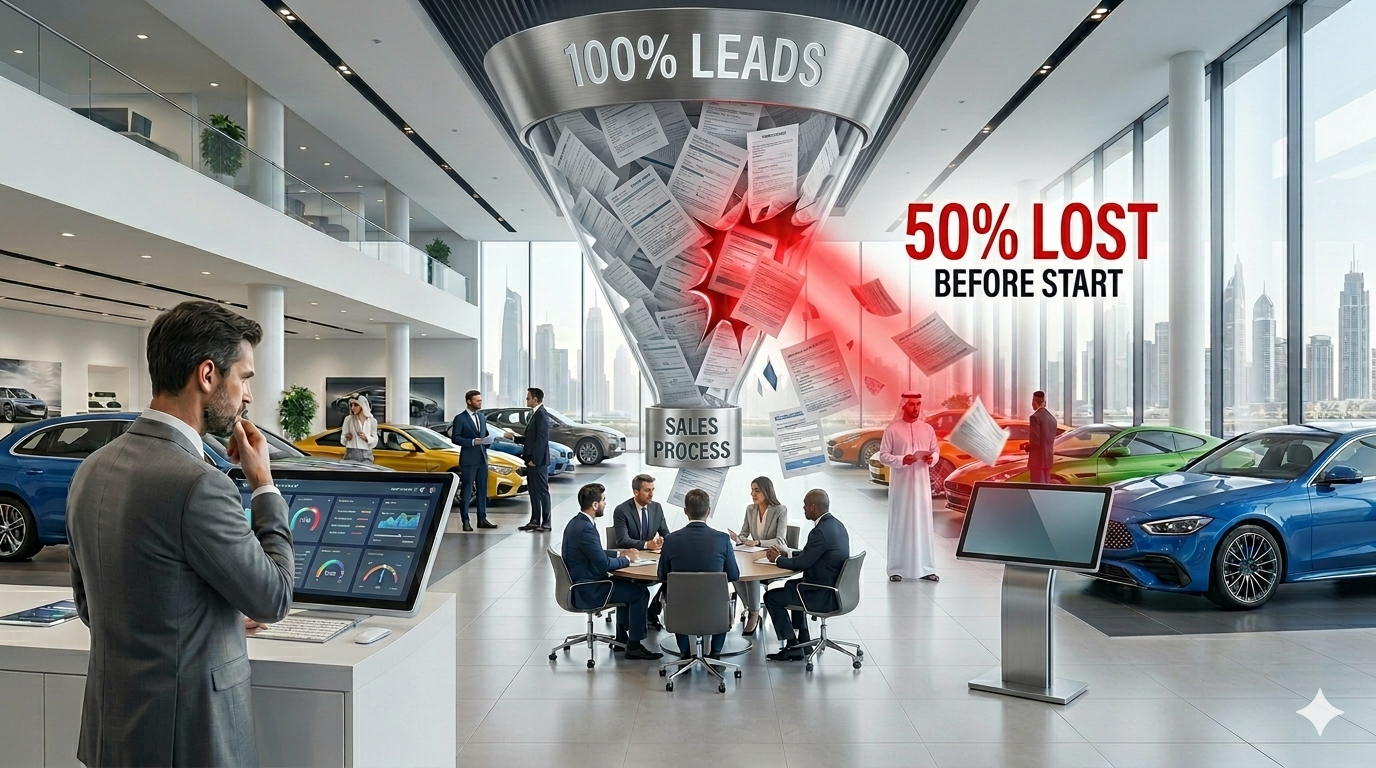
Most car dealerships in the MENA region spend heavily to generate leads – then lose a large share of them through slow, low-quality, and inconsistent follow-up.
This guide explains where the lead funnel breaks, what it costs, and the five fixes that turn marketing spend into measurable sales.
Walk into any Dealer Principal’s office in the MENA region and ask about marketing investment. They will tell you, in detail, what they spend on digital advertising, third-party lead aggregators, social campaigns, launch activity, and showroom traffic generation. The numbers add up. The reporting is thorough. The expectation of return is reasonable.
Now ask what happens to a lead after it lands in the dealership.
The answer is almost always vaguer. Some leads get called back quickly. Some sit. Some get a generic email. Some never receive a meaningful response at all. The CRM dashboard reports a follow-up rate that no senior leader inside the building actually believes. The Sales Manager is sure his team is responsive. The BDC, where there is one, is busy. And somewhere in the gap between the marketing spend and the customer who never came back, a significant portion of the dealership’s commercial opportunity is leaking away.
This is the most expensive operational problem in MENA automotive retail today – and almost nobody is treating it that way.
Lead Response Time: The Maths Is Brutal
Multiple independent studies of dealer lead response performance point to the same conclusion. A response to a customer enquiry within five minutes is roughly nine times more likely to convert than a response within thirty minutes. A response within the first hour wins the customer in nearly four out of five cases. Wait beyond an hour and conversion probability collapses, because the customer is already in conversation with someone else.
That is the global benchmark. The regional reality is significantly worse.
Industry data from the largest available study of dealer lead response – conducted across 1,700 franchise dealerships – found that 19% of dealers still take more than an hour to respond to a customer enquiry, and 4% never respond at all. Across the MENA region, where formal benchmarking studies are scarcer, mystery shopping consistently reveals the same picture: average response times measured in hours rather than minutes, response quality that frequently omits pricing or alternative inventory, and follow-up discipline that drops off sharply after the first contact.
The Four Failure Points in the Dealer Lead Funnel
The Dealer/Importer lead funnel in the MENA region has four common failure points. Each of them is fixable. None of them are being fixed at the pace the market now requires.
1. Speed of response
Customers submitting an enquiry through a dealer website, a third-party aggregator, or a social channel expect a response in minutes, not hours. Yet across the region, average dealer response time remains stubbornly above the threshold where conversion probability collapses. The cause is structural: BDC capacity is underbuilt, after-hours coverage is patchy or non-existent, and lead-routing systems are often a generation behind global standards.
2. Quality of response
Even when responses are fast, they are frequently low-value. The single most replicated finding in dealer lead response studies is that the majority of responses fail to include the basic information the customer is actually asking for: pricing, availability, alternative options, and finance indications. Generic replies asking the customer to “call the dealership” are still the most common response. In a competitive market, a fast but useless response can be worse than no response at all – it confirms to the customer that this dealership is not serious about their enquiry.
3. Follow-up discipline
Most regional dealerships make a first contact attempt within a reasonable window. Many fewer make a second. Very few run a structured sequence of three to five contacts across multiple channels (call, email, SMS, WhatsApp) over the first seven to ten days. Yet industry data consistently shows that conversion increases significantly with each subsequent contact attempt, up to about five attempts. A dealership that contacts a lead once and waits is leaving the majority of its conversion potential on the table.
4. Data integrityThe CRM in most regional dealerships does not tell the truth. Leads are marked “contacted” when no meaningful conversation took place. Leads are marked “lost” when no real attempt was made. Lead-source attribution is unreliable, which means marketing spend is being optimised against bad data. The honest gap between what the CRM reports and what actually happened to each individual lead is the single most useful piece of operational intelligence a Dealer Principal can develop – and almost none of them have it.
Why Mystery Shopping Exposes the Real ProblemThere is a particular reason this problem is not being solved across the region, and it is not because senior teams don’t care. It is because the people running the dealership do not have an honest view of what is actually happening.
The Sales Manager believes the team is responsive because the CRM dashboard says so. The Dealer Principal believes the BDC is performing because the headline appointment count is being met. The General Manager believes the digital marketing is working because lead volume is on target. None of them have an objective view of what happens to each individual customer enquiry, end to end, in real time.
This is what independent mystery shopping is for. Submitting structured enquiries through the same channels real customers use – then tracking response speed, response quality, follow-up sequence, and conversion to appointment and showroom visit — produces the only honest picture of how the lead funnel is performing. The gap between what the internal team believes and what mystery shopping actually finds is, in most regional dealerships, embarrassingly wide. And it is the most expensive thing in the business.
The Five Fixes That Move the NeedleThe Dealers/Importers who have closed the lead handling gap share five operational commitments. None are technologically heroic. All require senior leadership ownership.
1. A defined lead-response SLA, measured and enforced. Every inbound lead is responded to within a set time window, in a set format, with set content (vehicle confirmation, pricing indication, alternative options, clear next step). The standard is not aspirational – it is measured per lead, per agent, per day, and enforced.
2. A structured multi-touch follow-up cadence. A minimum of five contact attempts across at least three channels over the first ten days, with a defined script for each touch and a clear handover protocol from BDC to sales floor when the lead is qualified. No lead is allowed to “go quiet” without explicit closure.
3. Twenty-four-hour coverage of inbound enquiries. The customer enquiring at 11pm on a Friday is not waiting until Sunday morning. AI-powered first response, BDC after-hours coverage, or a combination of both ensures that no enquiry sits unattended for more than fifteen minutes, regardless of when it arrives.
4. Honest CRM data discipline. “Contacted” means a documented meaningful conversation occurred. “Lost” means a documented attempt sequence was completed. Lead-source data is validated. The CRM tells the truth, and senior leadership reviews exception reports weekly rather than waiting for the monthly review.
5. Continuous independent mystery shopping. Not annual sampling – a structured ongoing programme that benchmarks response speed, response quality, follow-up cadence, and showroom experience against defined standards, with results fed directly into Sales Manager and BDC Manager performance reviews. The honest external view is the only thing that corrects the internal blind spot.
What Closing the Lead Handling Gap Is WorthFor a typical mid-volume Dealer/Importer handling 500 inbound digital leads per month at an average cost-per-lead of USD 25–35, the commercial impact of closing the lead handling gap is significant.
Moving conversion from an industry-average 2% to a top-performing 8–10% on the same lead volume represents three to four times the unit sales from the same marketing spend. The acquisition cost per sold unit collapses. The marketing ROI transforms. And the additional units carry full F&I, finance, and aftersales annuity behind them.
This is not theoretical. It is what operators who have invested in lead handling discipline are already achieving. The gap between best-in-class and average in MENA automotive lead handling is the widest performance gap in the regional industry – and the single most addressable.
Three Questions Every Dealer Principal Should Ask This QuarterThree questions, asked honestly, will tell any Dealer Principal where their business actually sits:
1. What is your real average lead response time – measured by independent mystery shopping rather than by the CRM dashboard?
2. What is the gap between your CRM-reported follow-up rate and the actual follow-up sequence experienced by a real customer enquiring on a Tuesday evening?
3. What proportion of your inbound leads convert to a meaningful first conversation, a showroom visit, and ultimately a sale – broken down by lead source?
The data, if collected honestly, will almost always tell the same story. The dealership is paying full price for its marketing investment and capturing a fraction of the available return because of operational discipline gaps the senior team has never had visibility on.
The customers who never came back to your showroom are not lost because of price, product, or competition. In most cases, they are lost because somebody at your dealership did not answer them quickly enough, did not answer them well enough, or did not follow up at all. The marketing spend is the cost. The lead handling is the conversion mechanism. And right now, across most of the MENA region, the conversion mechanism is the weakest link in the chain.
This is a fixable problem. It is also, increasingly, the difference between Dealers/Importers who will lead their markets through the second half of this decade and those who will spend it wondering why the same marketing budget is producing fewer results.
Key Takeaways- A lead answered within 5 minutes is up to 9x more likely to convert than one answered within 30 minutes.
- 78% of buyers purchase from the dealer who responds first – speed is a primary commercial lever, not an operational detail.
- The MENA lead funnel breaks at four points: speed, quality, follow-up discipline, and CRM data integrity.
- Most CRMs overstate follow-up performance; only independent mystery shopping reveals the truth.
- Lifting conversion from 2% to 8–10% on the same lead volume can deliver 3–4x more units from the same marketing budget.
About AMENA AutoAMENA Auto is the leading automotive consultancy and training partner for OEMs and Dealers/Importers across the MENA region. From sales performance and BDC optimisation to aftersales, parts, F&I, CSI and NPS programmes — and structured mystery shopping of the full customer journey — we help operators across the GCC, North Africa, and the wider region convert marketing investment into measurable commercial performance.
Our consulting, training, mystery shopping, and AI-powered customer experience monitoring are built around one operating philosophy: Find More, Win More, Keep More Clients.
To find out how AMENA Auto can help your business close the lead handling gap and transform the return on your marketing spend, visit www.amenaauto.com or contact our team directly.
Contact Us Today! At office@amenaauto.com
Follow us @ Linkedin | Youtube| Instagram | Facebook
We express our sincere gratitude to all the veterans and experienced professionals in the automotive industry for their valuable input and advice when we write our articles. We take pride in our commitment to embracing technology, including AI, to enhance the quality of our articles.